



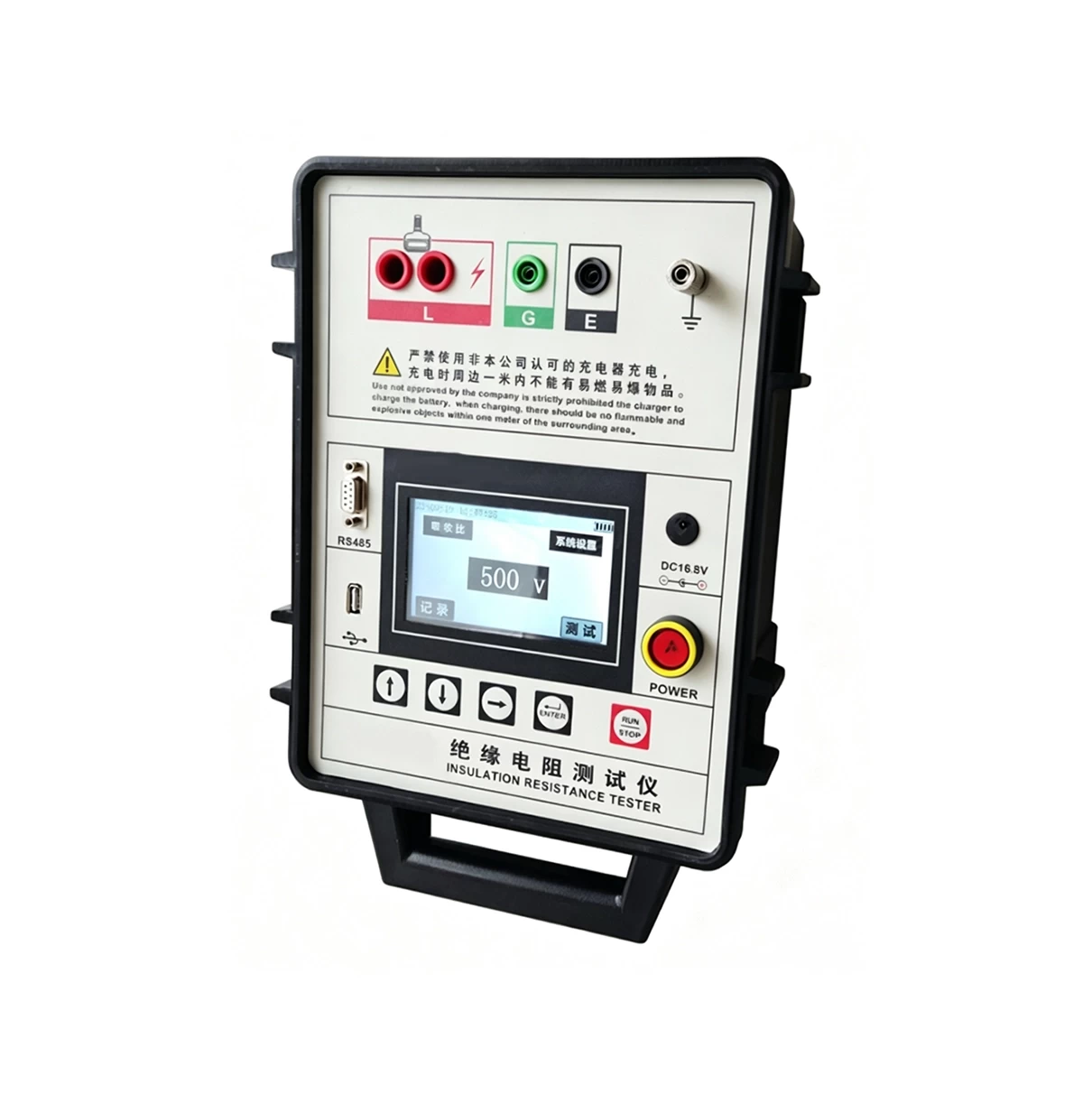
Insulation Resistance Tester
Product Overview
The VERXON Insulation Resistance Tester is designed for onsite and laboratory insulation-resistance measurements. Its test source and discharge circuit are suitable for electrical equipment with significant capacitance, while digital filtering supports stable measurement in environments with electrical interference.
The test voltage, measurement range and accessory configuration are selected according to the test object and applicable test requirements.
Applications
Transformer insulation-resistance testing
Power cable insulation assessment
Bushing and insulator testing
Motor and generator insulation inspection
Switchgear and electrical equipment maintenance
Factory, laboratory and field testing
Product Functions
Generates a controlled insulation test voltage
Measures and displays insulation resistance
Supports insulation-condition trend assessment
Suppresses power-frequency interference
Automatically discharges capacitive test objects
Stores, exports and prints test data
Product Features
Strong load capability for capacitive specimens
Protection against short circuit, breakdown and abnormal current
Rapid automatic discharge
Clear menu and test-result display
Battery-powered field operation available
Configurable communication and data-management options
Frequently Asked Questions
Which equipment can be tested?
The instrument can be configured for transformers, cables, bushings, insulators, motors, generators, switchgear and other insulated electrical equipment.
Why is rapid discharge required?
Cables, transformers and other capacitive specimens can retain electrical charge after a test. Rapid discharge helps make the test object safe before disconnection.
Can it be used in a substation environment?
Yes. Digital filtering and interference-suppression functions support field measurement when the instrument is correctly connected and grounded.
Does the instrument support data export?
Data storage, printing and wired or wireless export functions can be included according to the selected configuration.
How are the test voltage and range selected?
They are determined according to the test object, applicable standard and agreed technical requirements.